ACCELERATING INFRASTRUCTURE
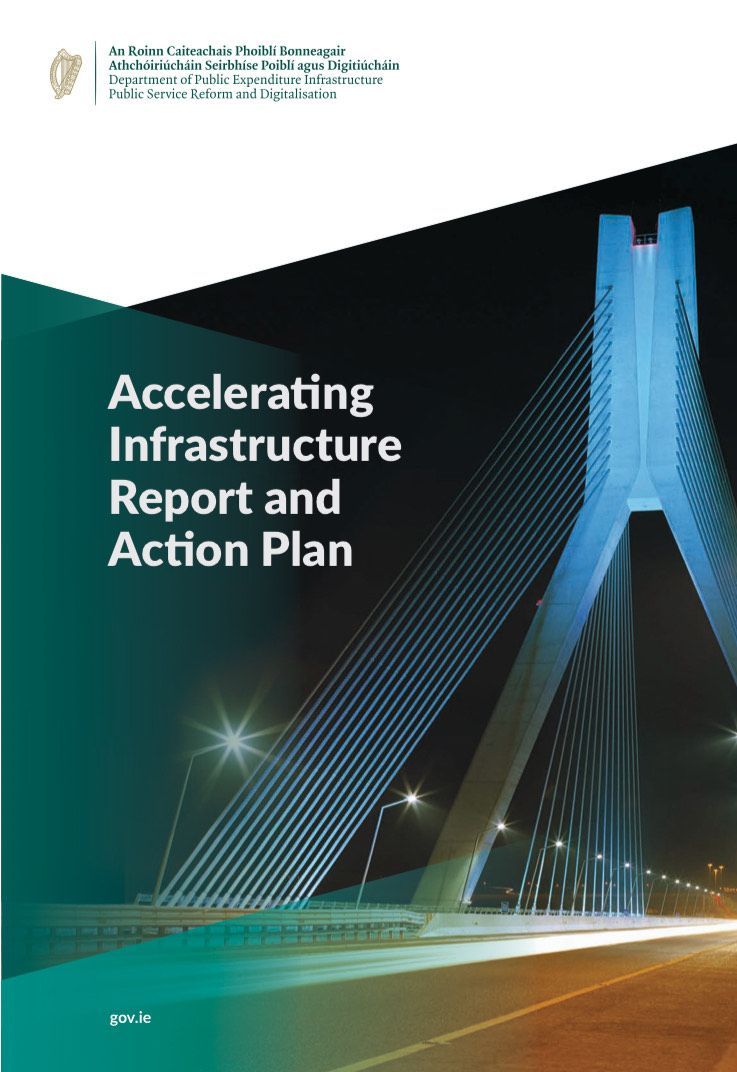
THE GOVERNMENT'S ACCELERATING INFRASTRUCTURE POLICY - December 2025.
Without adequate infrastructure including power, water, and transport, Ireland cannot build the houses, provide public services and build a sustainable economy.
A Taskforce was set up by the Government in May 2025 to examine how the provision of infrastructure could be accelerated given how long it has generally taken to deliver over the years.
Jack Chambers, the Minister for Public Expenditure, Infrastructure, Public Service Reform, and Digitalisation Chaired the Taskforce. Its members were
- Mr. Sean O’Driscoll – Chairman of the Economic and Social Research Institute (ESRI) and former Chairman and Chief Executive of the Glen Dimplex Group
- Ms. Mary Hughes – Chartered Town Planner with in excess of 25 years experience
- Ms. Michele Connelly – Former partner in KPMG and Head of Global Infrastructure
- Mr Feargal O’Rourke – Chairman of IDA Ireland
- Mr. Eamon Booth – Former MD of John Paul Construction
- Ms. Imelda Mannion – Former Jacobs VP for Global Programme Management
- Chair of the Major Projects Advisory Group
- CEO of Uisce Éireann
- Managing Director of ESB Networks
- CEO of Land Development Agency
- Interim CEO of National Transport Authority
- Former Chief Executive of Waterford City and County Council
Their Report, published in November 2025, is now Government Policy, in the form of an Accelerating Infrastructure Action Plan.
SAMRA believes that the Policy can be very beneficial for the delivery of a multi-agency project along Strand Rd, comprising the current flood defences project, and the incorporation into it of an off-road cycle way, as well as a possible interceptor drain to eliminate raw sewage discharges onto the beach. It would also be very beneficial for the S2S Merrion Gates to Dun Laoghaire project across its many features.
The 4 key Pillars of the Report/Policy are
Legal Reform - to lessen the reliance on the Courts as arbitrators of Planning and Regulatory decisions and thus mitigate delays in statutory approvals for critical infrastructure - a couple of examples
- Reforms around Judicial Reviews processes and procedures, which have stymied many key projects across the State, such as considering legal costs payable to applicants and early assessment by the Courts of the likely success of a JR.
- From a legislative perspective, simplifying the scope and scale of environmental documentation required as part of the approvals process.
- In the case of such Stand Rd projects noted above, the proposed Legal Reforms could simplify the environmental documentation required for the projects and speed up any potential Judicial Review.
Regulatory Reform and Simplification - to accelerate approvals by the various agencies - again a couple of examples
- Having national planning statements for critical infrastructure, against which both developers can prepare and agencies assess proposals.
- Consents/Licences/Permits to be parallel with the Planning Process, rather than in sequence as presently.
- Again, these reforms could speed up the Planning process and thus the delivery of the projects.
Coordination and Delivery Reform - obligations on state agencies to coordinate delivery of various projects in a particular location.
- In the Strand Road case, the OPW/DCC on the flood defences project, the Local Authority's/NTA on the provision of cycling infrastructure, and Uisce Eireann's responsibilities in delivering drainage infrastructure
The last Pillar - Public Acceptance - to put in place mechanisms through which the State can build public acceptance for critical infrastructure.
- The Community Gain of an off-road cycle way should boost the public's support of the flood defences design solution.
There are 30 main actions across all these pillars, with designated Government and agencies responsibilites, and which are time bound, mainly to be executed this year, so an aggressive and impressive schedule.